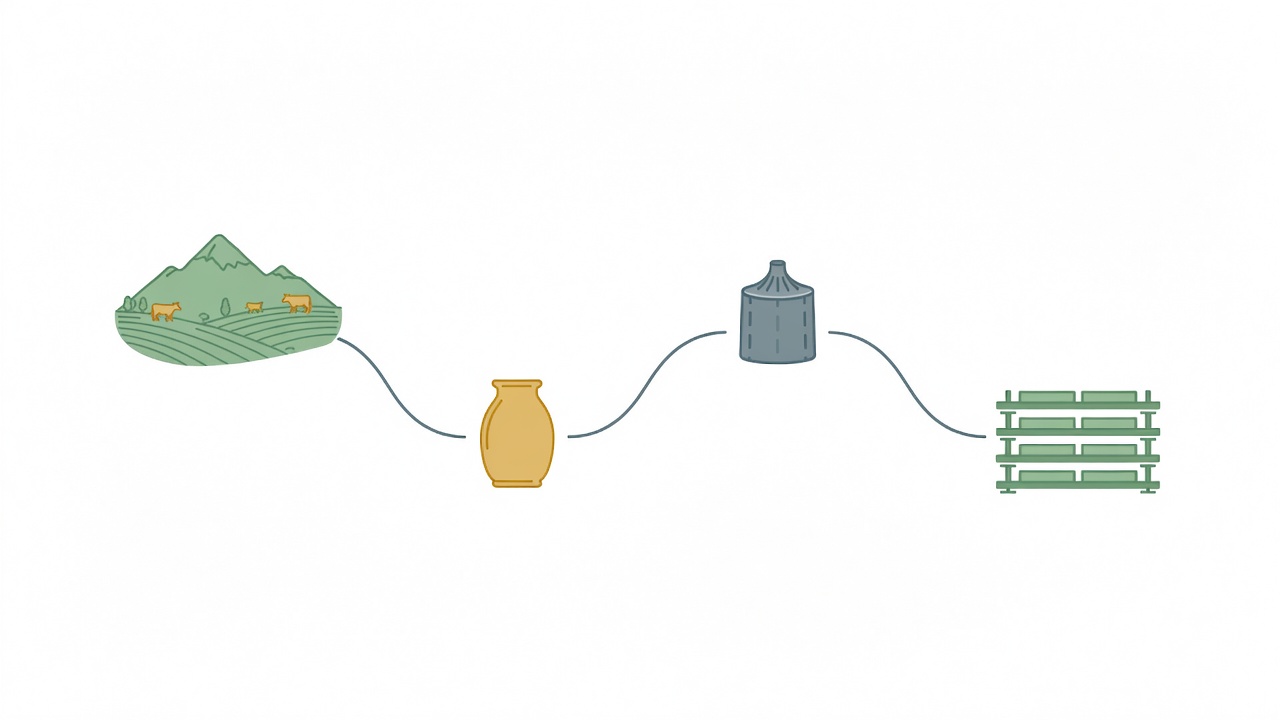
Place is a starting point, not a flavour guarantee
Alpine dairy traditions developed across connected but distinct landscapes. Savoie and Haute-Savoie in France, Valais and Gruyère in Switzerland, the Austrian state of Vorarlberg and Italy’s Valle d’Aosta all offer useful reference points. Their cheeses are not variations of one universal mountain product. Local husbandry, production rules, scale and eating habits matter. A contemporary restaurant becomes more interesting when it identifies those differences rather than wrapping everything in a general story about altitude.
Seasonal movement between lower farms and higher grazing land can influence milk production and cheesemaking. However, an Alpine name does not automatically mean the milk came from summer pasture. Nor does it prove that every stage happened in a small chalet. If the menu makes a specific claim about mountain production, ask which producer and season it refers to. A precise answer is more useful than a romantic one.
Milk supplies possibilities
Cow’s milk is central to many familiar Alpine cheeses, but sheep’s and goat’s milk also belong to mountain food cultures. Species affects composition, yet feeding, animal health and production choices complicate any simple flavour rule. Avoid assuming that goat’s cheese must be sharply acidic or that cow’s milk always produces a mild cheese. The finished product reflects a chain of decisions, not just the animal pictured on a menu.
Raw milk and pasteurised milk describe different treatments of the starting ingredient. Neither label alone tells you whether a cheese will melt well, taste strong or suit a particular diner. Some protected cheeses specify raw milk; other regional products permit different treatments. People who are pregnant, immunocompromised or otherwise medically vulnerable should follow relevant health guidance and ask about the actual product and preparation. A hot-looking dish is not a substitute for reliable safety information.
Curd handling builds the structure
Cheesemaking transforms milk through coagulation, separation and moisture control. Cultures develop acidity, while rennet or another coagulant helps form the curd in many cheese styles. Cutting, stirring, warming, draining and pressing then influence how much moisture remains. These processes help explain why one cheese can be sliced thinly, another can be scraped after heating and another behaves better as a grated ingredient.
“Cooked curd” refers to a stage of cheesemaking, not simply to a cheese being heated in a restaurant. Likewise, a pressed cheese and a soft cheese are not interchangeable cooking materials. A kitchen may combine cheeses to balance flavour, body and melting behaviour. That blend can be thoughtful rather than inauthentic, provided the restaurant explains what it is making instead of presenting a new mixture as a fixed historical recipe.
Ripening is active work
Ageing is not merely leaving a wheel alone. Temperature, humidity, turning, brushing and rind care influence development. Washed rinds, natural rinds and other surface treatments create different environments. Reblochon de Savoie, Beaufort, Comté and Le Gruyère AOP illustrate why a single word such as “mountain” cannot predict texture or aroma. Comté comes from the Jura, an adjacent mountain tradition that deserves its own geographical identity rather than being casually relabelled as Alpine.
A ripe cheese is also not necessarily the oldest available cheese. Maturity should fit the intended use. A very developed cheese might bring excellent depth to a small tasting but dominate a delicate preparation. In a restaurant, storage and service temperature continue the cheesemaker’s work. Ask what the kitchen likes about this particular wheel; the answer may reveal more than an age stated without context.
Read protected names carefully
Appellation d’origine protégée, abbreviated AOP in French, and Denominazione di origine protetta, or DOP in Italian, identify protected designations under their respective systems. Switzerland also uses AOP protection under Swiss law. Fontina DOP, Beaufort AOP and Raclette du Valais AOP each have their own specification. A protection scheme defines origin and production requirements; it is not a promise that every diner will prefer every example.
Generic style names and protected designations are not equivalent. “Raclette” may refer to cheese, a dish or a service method, whereas a full protected name is more specific. For official background, consult INAO, the Swiss AOP-IGP association or the Fontina consortium. Then bring the question back to the table: which cheese is being served, who made it and why was it chosen for this dish?